
A lot of companies begin their application security journey with Snyk. It’s easy to see why — the tool puts developers first and enjoys strong market recognition.
Over time, though, evolving security demands can highlight gaps. Some teams struggle with pricing clarity; others need better runtime protection or more flexible deployment options. The choice between consolidated platforms and individual point solutions, along with stricter compliance requirements, frequently pushes organizations to evaluate Snyk alternatives.
We’ve put five strong platforms — Aikido, Jit, Black Duck, FOSSA, and Oligo Security — side by side. The comparison looks at real-world factors like overall security coverage, how easy they are for developers, smart risk prioritization, compliance support, scalability, and the actual value they deliver.
In the end, this breakdown should give security and engineering leaders a clearer picture. It helps them pick the option that truly matches how their teams work and what they need day to day.
Evaluation Methodology
To find the right Snyk alternative, we put each solution through a practical evaluation based on what security and engineering teams actually need today. The idea wasn’t to chase every possible checkbox, but to see how effectively these tools handle real-world security, compliance, and operational demands.
The evaluation centered on several key areas:
- Security Coverage: Full stack — SAST to CSPM to supply chain.
- Developer Experience: Easy onboarding, smart integrations, actionable fixes.
- Risk Prioritization: Less noise — reachability, runtime, exploit validation.
- Compliance & Governance: SBOMs, licenses, policies, reports.
- Deployment Flexibility: SaaS, on-prem, hybrid, air-gap.
- Scalability: Enterprise-ready for big teams and complex setups.
- Pricing & Value: Transparent pricing, real value, no upsell fatigue.
These five platforms stood out for their adoption rates, feature breadth, and applicability to the difficulties that enterprises often face when looking beyond Snyk.
Top 5 Snyk Alternatives
Snyk is a popular choice for developer-first security, but alternatives now offer broader coverage, better pricing, or deeper specialization in runtime protection, license compliance, and enterprise governance. Below are the strongest Snyk alternatives, each aligning with different security and operational priorities.
Aikido

Aikido has earned a solid reputation as one of the top alternatives to Snyk. What makes it different is its all-in-one approach to DevSecOps. Instead of piecing together separate solutions for application security, cloud security, supply chain risks, and runtime monitoring, everything lives in one platform.
You don’t have to switch between tools for code scans, cloud posture checks, dependency analysis, or container security anymore. Aikido pulls it all together, which really helps reduce headaches. It continuously monitors your repositories, cloud setups, containers, APIs, and infrastructure, then smartly prioritizes findings according to their actual impact.
SAST and DAST scanning, software composition analysis, Infrastructure as Code checks, CSPM, malware detection, secret scanning, API security testing, runtime protection, and compliance monitoring are some of the key features. Additionally, it easily interacts with development environments, project management systems, and typical CI/CD technologies. This reduces security noise and enables teams to address problems more quickly.
Pros:
- All-in-one platform unifying code, cloud, container, dependency, secret, and runtime security.
- Fast deployment with low operational overhead, enabling easy scaling across large engineering teams.
- Developer-friendly workflows that cut alert fatigue and help teams fix real issues faster.
- Transparent pricing with no costly add-ons.
Cons:
- Different approach than traditional security tools.
- Migration from legacy security platforms may require onboarding.
- Limited focus on highly customized procurement processes.
Jit
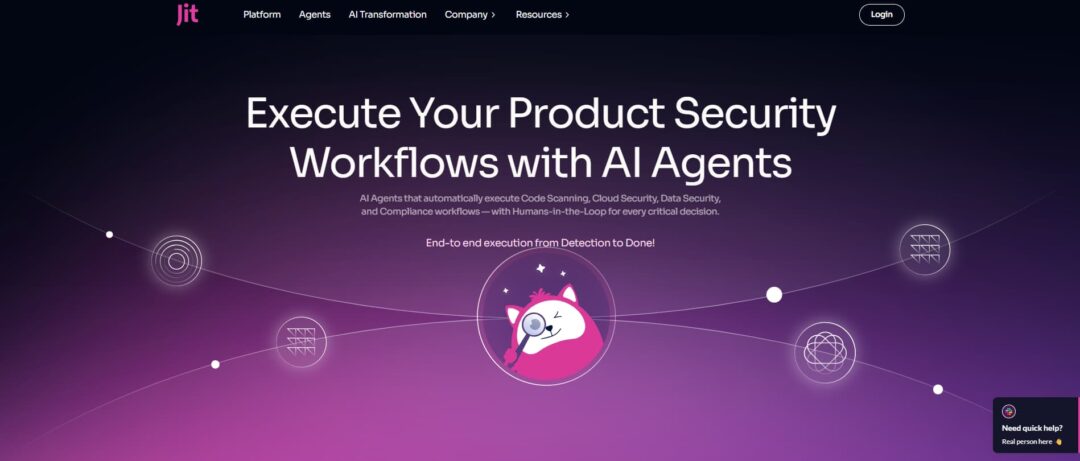
Jit is a DevSecOps platform that combines runtime security, cloud, infrastructure, and applications into a smooth process. Development teams may identify, prioritize, and address vulnerabilities across the whole software development lifecycle—without incurring significant overhead—instead of juggling disparate technologies.
The fact that Jit goes beyond code scanning is what makes it unique. To make risk management easier, it integrates several security disciplines and uses intelligent automation. Security checks are integrated into current engineering procedures, allowing developers to concentrate on development rather than context switching.
Among its main capabilities, you’ll find SAST, SCA, secrets detection, IaC scanning, container and cloud posture security (CSPM), DAST, Kubernetes and serverless scanning, CI/CD monitoring, AI-powered agents, runtime risk prioritization, automated fixes, team reports, and native GitHub/GitLab integrations.
Pros:
- Broad security coverage across code, cloud, infrastructure, API, and runtime in a single environment.
- Automated onboarding and repository discovery reduce setup time.
- AI-powered security workflows and runtime-based risk prioritization help focus on real-world threats.
- Strong developer-focused integrations with GitHub and GitLab.
Cons:
- Advanced features may take time for new teams to master.
- Large numbers of integrations can make the interface feel busy.
- Pricing may become less predictable as teams scale.
- Custom rule configuration is less flexible than some standalone tools.
- No on-premises or self-hosted deployment option.
Black Duck

Black Duck offers a comprehensive enterprise security platform that combines Software Composition Analysis (SCA), SAST, DAST, API testing, container security, and supply chain protection.
Instead of only hunting for bugs, it helps companies get a clear picture of risks in open-source components, proprietary code, binaries, firmware, AI-generated code, and other dependencies. What sets it apart from many developer-centric tools is its strong focus on supply chain visibility, compliance requirements, SBOM handling, and governance at scale.
This makes it easier for security, legal, and engineering teams to work together.
Notable features include broad testing capabilities, multi-format SBOM support, license compliance tracking, policy controls, cloud-native security, and the choice of SaaS, on-prem, or hybrid deployment.
Pros:
- Strong software supply chain visibility and dependency analysis.
- Advanced SBOM management for compliance-driven organizations.
- Broad application security testing coverage within one platform.
- Extensive governance, policy enforcement, and reporting capabilities.
- Supports regulated industries that require on-premises deployments.
- Includes open-source license compliance and risk management features.
- Recognized by major industry analysts for application security and SCA capabilities.
Cons:
- Resource-intensive for on-premises deployments.
- Setup and integration can be complex, especially in large environments.
- Scan performance may slow down on large codebases.
- User interface and reporting capabilities feel dated compared to newer platforms.
- Pricing can be high for smaller organizations.
FOSSA

FOSSA is an SCA platform centered on open-source compliance. It helps organizations manage security, licensing, and dependency risks across their software supply chain.
What sets it apart from many other tools is its stronger focus on license compliance, policy enforcement, and governance — rather than just vulnerability scanning. This makes it especially valuable for teams that want clear, detailed visibility into their open-source usage and legal responsibilities.
Scans codebases for components and dependencies while supporting compliance. Encourages collaboration across legal, security, and dev teams with strong audit trails. Standout features: license management, dependency tracking, custom policies, automated reports, CI/CD, and granular governance.
Pros:
- Best-in-class open-source license compliance and governance.
- Complete visibility into dependency licenses with customizable policy enforcement.
- Enterprise-ready reporting, audit trails, and access controls for large-scale programs.
- Bridges legal, security, and engineering teams with shared workflows.
- Tracks dependency history to analyze risk trends over time.
Cons:
- Vulnerability detection is secondary — best paired with a dedicated security scanning tool.
- Slower performance and an outdated interface compared to newer competitors.
- Lacks line‑of‑code triage, slowing down developer debugging.
- Not ideal for teams whose primary need is security vulnerability scanning over license compliance.
Oligo Security

Oligo Security focuses on runtime protection for applications. Rather than stopping at static analysis or dependency scanning, it examines live application behavior to determine whether vulnerable libraries and functions are actually executed in production.
The result is far less noise and much more effective prioritization. Security teams can zero in on genuine threats while gaining better insight into both internal and third-party code. The platform brings together runtime observability, exploit validation, software supply chain security, and smart vulnerability management for more actionable intelligence.
It offers features like runtime-based prioritization, execution analysis, ongoing SBOM creation, VEX reporting, supply chain monitoring, third-party risk assessment, and real-time production risk visibility.
Pros:
- Prioritizes real exploitability in production, dramatically reducing noisy alerts.
- Maintains live SBOMs and delivers instant analysis on new threats.
- Strong insights into how both first-party and third-party software run in real environments.
- Helps teams focus remediation where it counts, freeing up valuable engineering time.
- Efficient sensor design keeps runtime monitoring relatively lightweight.
Cons:
- Lacks automatic code repair. It detects and can block exploits, but fixing the source code remains a manual task for developers.
- Not a complete cloud security posture tool. You may need to pair it with other solutions for full misconfiguration and IAM coverage.
- More limited post-incident capabilities compared to tools built around detailed forensics and ticketing.
- Some architectures might notice slight overhead from in-depth function monitoring.
Conclusion
The best Snyk alternatives vary based on your specific security goals, team setup, and compliance environment.
Aikido offers broad consolidation for teams, replacing several tools. Jit shines with its smooth developer experience and AI automation. Black Duck is favored by enterprises needing strong supply chain controls and on-prem options. FOSSA leads on open-source licensing risks, and Oligo takes a runtime-driven approach to highlight real production threats.
There’s no universal winner. Evaluate options against coverage, ease of use, prioritization, compliance, scalability, and cost to pick what suits your risk tolerance.