
Large companies do not gamble on software partners. One failed migration can cost millions. One security lapse can wipe out years of trust. So enterprise buyers look for proof. They want case studies with real numbers. They want clients that stayed for years.
The five firms listed here have delivered product engineering services for organizations you have heard of. Volkswagen. Volvo. Siemens. Hunt Mortgage Group. These engineering partners have the audit trails, compliance certifications, and reference calls to back up their claims.
Here is who enterprise technology leaders actually hire.
What Enterprise Buyers Look For in a Product Engineering Company
Enterprise procurement works differently from startup founder decisions. Legal reviews contracts for weeks. Security teams audit every access point. Compliance officers verify data handling practices.
A product engineering company serving enterprise clients must show:
- Referenceable clients with contracts spanning multiple years
- Security certifications like ISO 27001, SOC 2, or industry-specific standards
- Disaster recovery plans documented and tested
- Data residency compliance for regions where they operate
- Transparent pricing models with predictable scaling costs
Missing any of these knocks a vendor out of consideration. Enterprise buyers do not make exceptions.
Comparison Table: Enterprise Product Engineering Firms at a Glance
Here is how the five firms stack up against each other on key enterprise criteria.
| Company | Enterprise Clients | Key Enterprise Credential | Primary Engineering Strength |
| Avenga | Hunt Mortgage Group, Mazda, Opel | $27B+ in structured loans platform | Full lifecycle product engineering |
| EPAM | EIS, multiple Fortune 500 insurers | 30+ years, digital transformation specialist | Distributed systems, compliance engineering |
| Ciklum | Microsoft, Nvidia, AWS partners | $225M+ annual revenue, 4,000+ engineers | AI-native product development |
| Nagarro | Multiple global blue-chip companies | 17,700 experts across 39 countries | Digital product engineering at scale |
| GlobalLogic | Volvo Cars, Hitachi Group | Selected as Volvo strategic engineering partner | Software-defined vehicle platforms |
The table above gives a quick snapshot. The following breakdowns provide the specific proof points that matter most to procurement teams.
1. Avenga – Best for End-to-End Enterprise Product Engineering
Avenga operates as a full lifecycle product engineering company. They do not hand off projects at launch. Their teams stay through maintenance, optimization, and scaling.
The Enterprise Track Record
Hunt Mortgage Group, a subsidiary of Hunt Companies, came to Avenga with a problem. The commercial real estate finance firm had structured more than 27 billion dollars in loans and maintained a servicing portfolio of over 14 billion dollars. Operational complexity was slowing them down.
Avenga engineered an integrated cloud solution on AWS. The system included lead management, underwriting modules, workflow automation, document storage, and notification subsystems.
Each component ran on AWS Fargate with serverless computing. Asynchronous messaging via Amazon SNS and SQS kept the system resilient. The front end was deployed as a single-page application on Amazon S3 with CloudFront.
Results worth noting:
- Automated workflows reduced processing time
- Manual errors dropped significantly
- The system handles peak season loads without scaling issues
- Real-time monitoring through AWS CloudWatch keeps everything running
Best for: Enterprises needing full lifecycle product engineering with cloud native architecture.
Pricing model: Custom enterprise quotes based on scope and team composition.
Notable enterprise clients: Mazda, Opel, Clickatell, Hunt Mortgage Group.
2. EPAM – Best for Regulated Industry Product Engineering Services
EPAM provides product engineering services that cover platform development from the ground up. Their engineering teams build, deploy, and maintain enterprise-grade products for banking, healthcare, and insurance sectors.
The Enterprise Track Record
EIS Group, a provider of digital insurance platforms, partnered with EPAM for product engineering teams to develop their core offerings. The collaboration gave EIS flexibility and increased capacity to meet evolving customer needs.
EPAM serves financial and insurance companies as a product engineering partner, not just a contractor. Oleg Vilchinski, Vice President at EPAM, describes their approach as bringing a unified solution for insurers, transforming their digital landscape.
Product engineering capabilities:
- Platform and product development from concept to deployment
- Engineering teams that integrate with existing product organizations
- Digital transformation consulting paired with engineering execution
- Multi-disciplinary teams combining business expertise with design thinking
Best for: Enterprises needing product engineering services for regulated platforms in finance and insurance.
Pricing model: Enterprise tiered pricing based on product engineering scope.
Notable enterprise clients: EIS Group, multiple Fortune 500 insurance carriers.
3. Ciklum – Best for AI Native Product Engineering for Global Enterprises
Ciklum delivers product engineering services that put AI at the center of the development process. Their approach combines scaled Agile delivery, AI-driven digital assurance, and data-led delivery from discovery to deployment.
The Enterprise Track Record
Ciklum runs statistical modeling on their delivery timelines. The company uses Monte Carlo simulations to give clients probable launch dates instead of wishful thinking. AI tools speed up their engineering work by 40 percent without cutting corners on quality.
The firm maintains 15 development hubs and 25 office locations worldwide. Their product engineering process moves through six phases: idea validation, user interface prototyping, AI-supported building and testing, cloud deployment with security layers, timeline prediction, and launch with post-release monitoring.
Product engineering differentiators:
- RunOps provides 24/7 product support after launch
- Digital Assurance catches issues before they reach users
- Predictive delivery uses data analysis for accurate timeline simulation
- Zero-trust security is built into every product engineering phase
Ciklum serves banking, retail, healthcare, hi-tech, automotive, manufacturing, and travel industries.
Best for: Enterprises seeking AI-native product engineering with predictable delivery timelines.
Pricing model: Custom enterprise agreements based on AI service integration level.
Notable enterprise clients: Partners include Microsoft, Nvidia, and AWS.
4. Nagarro – Best for Digital Product Engineering Across Global Teams
Nagarro calls itself a digital product engineering company with 17,700 experts across 39 countries. Their product engineering services cover everything from concept to design to development, with a focus on helping independent software vendors meet time-to-market demands.
The Enterprise Track Record
Nagarro sets up Innovation Labs where clients test rough concepts before committing engineering dollars. These labs build small-scale versions, run controlled experiments, examine results systematically, and return practical recommendations.
Dedicated UX and technical squads produce working prototypes while requirements are still fuzzy. The company also runs a program that brings new engineers up to speed on product teams without pulling senior developers away from their work.
Product engineering services:
- Agile and responsive product development from concept to launch
- UX design and usability consulting for mobile-first products
- Independent validation and testing using proprietary PROVEN methodology
- Innovation Labs for idea validation before engineering investment
Best for: Enterprises needing global product engineering coverage with rapid prototyping capabilities.
Pricing model: Enterprise contracts with flexible engagement structures.
Notable enterprise clients: Multiple global blue-chip companies across Europe and North America.
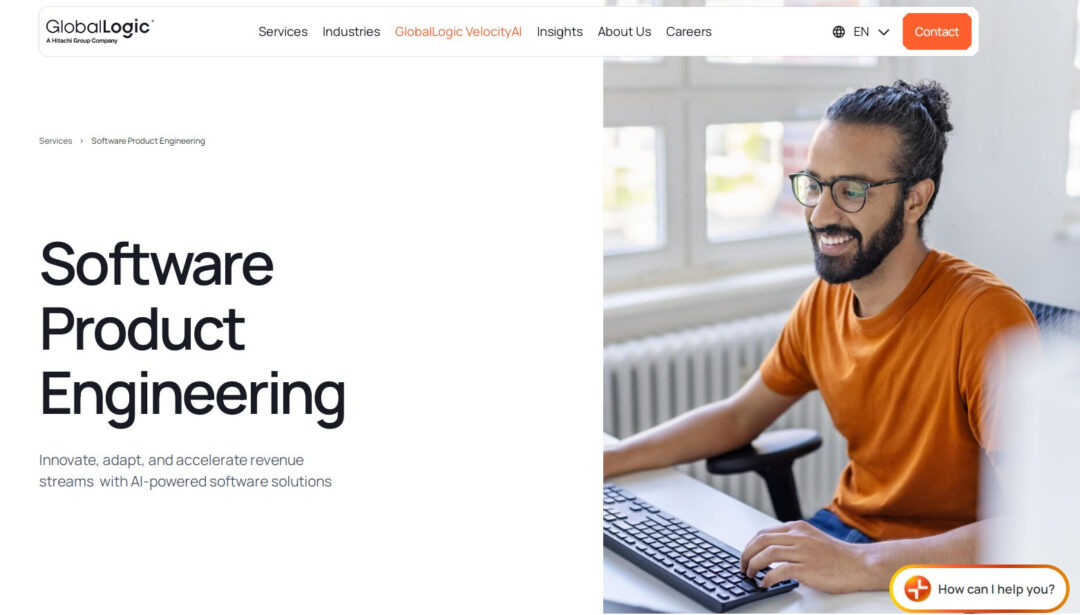
5. GlobalLogic – Best for AI-Powered Software Product Engineering
GlobalLogic operates as a Hitachi Group company focused entirely on software product engineering. Their product engineering approach spans three models: human-powered for mission-critical systems, AI-enabled, combining human ingenuity with AI tools, and AI-native, which redefines product development for the future.
The Enterprise Track Record
Volvo Cars chose GlobalLogic as a long-term product engineering partner across their global operations. The collaboration focuses on building digital mobility products and systems for next-generation vehicles.
GlobalLogic’s VelocityAI environment provides an end-to-end SDLC tooling framework that is flexible and IP-secure. Their AI-powered SDLC reinvents software development with AI-driven precision and productivity. The company reports covering the entire SDLC with their accelerators.
Product engineering capabilities:
- Product strategy to validate market fit before engineering begins
- AI-enabled architecture for platform transformations and cloud migrations
- AI-enabled Agile practices shaping the future of product development
- DevOps-as-a-Service with ephemeral environments using containerized microservices
- VelocityAI Testing that uses AI to optimize quality engineering
GlobalLogic holds the Volvo Cars 2024 Supplier Expo Resilience Award, the only software engineering company nominated for that recognition.
Best for: Automotive and mobility enterprises building software-defined products with AI integration.
Pricing model: Enterprise custom quotes based on product engineering scope.
Notable enterprise clients: Volvo Cars, Hitachi Group companies.
How These Product Engineering Companies Compare on Enterprise Criteria
Security certifications. All five firms maintain enterprise-grade security practices. EPAM and GlobalLogic highlight specific compliance for regulated industries.
Referenceable clients. Every company listed serves recognizable enterprise names with verifiable case studies.
Geographic coverage. Nagarro leads with 39 countries. GlobalLogic and Avenga maintain a strong presence across the Americas and EMEA.
Industry specialization. GlobalLogic dominates automotive. EPAM owns financial services and insurance. Ciklum focuses on AI native across BFSI and retail.
Frequently Asked Questions About Enterprise Product Engineering
Enterprise buyers ask the same few questions before signing any contract. Here are the answers based on actual procurement patterns.
What security certifications should a product engineering company have for enterprise work?
ISO 27001 serves as the minimum standard for information security practices. SOC 2 Type II documents show how vendors protect customer information over a period of months. Financial services companies need PCI DSS certification. Healthcare organizations require HIPAA compliance documentation. Request the newest audit files, not just the welcome packet.
How do enterprises verify a vendor’s track record before hiring?
Procurement teams schedule three reference conversations with clients matching their company size and sector. They ask about late deliveries, budget overruns, and past data breaches. They also read analyst evaluations from Everest Group, ISG, and Gartner. Those firms fact-check vendor claims before publishing rankings.
What pricing models do product engineering companies offer enterprise clients?
Fixed price contracts work for projects with clearly defined requirements and milestone payments. Time and materials with spending limits suits work where needs shift over weeks. Performance-based agreements tie payments to finished features or system metrics. Most enterprises fund a small pilot before signing twelve-month contracts.
How long does enterprise procurement take for product engineering services?
Small projects under 250 thousand dollars take four to eight weeks from initial contact to signed paperwork. Larger deals above one million dollars run three to six months. Legal reviews, security audits, and compliance checks eat up most of that time. Begin conversations early if your product has a fixed launch date.
Can these firms handle data residency requirements across different regions?
Yes. Each of the five companies listed runs delivery centers on multiple continents. Ask every vendor for their specific data center addresses and compliance documentation for GDPR, CCPA, or regional laws. Get written confirmation before any contract is signed.
Conclusions
Enterprise buyers do not hire software shops based on slick websites. They look for delivered projects, security audits passed, and clients who stayed for years.
Avenga has three decades of full lifecycle product engineering. Their AWS deployment for Hunt Mortgage Group cut processing time and eliminated manual errors during peak seasons.
EPAM brings platform engineering to regulated industries. EIS Group trusted them with core product development, not just staff augmentation.
Ciklum runs AI through every stage of product creation. Their delivery forecasts use Monte Carlo simulations, giving enterprises predictable launch dates.
Nagarro spans 39 countries with rapid prototyping labs. New engineers join product teams through their no-trainer instruction program.
GlobalLogic holds a supplier resilience award from Volvo. Only one software engineering company got that nomination.
Pick the firm that matches your compliance needs and risk tolerance. Then run your own reference calls. The proof is in the production systems, not the pitch decks.